
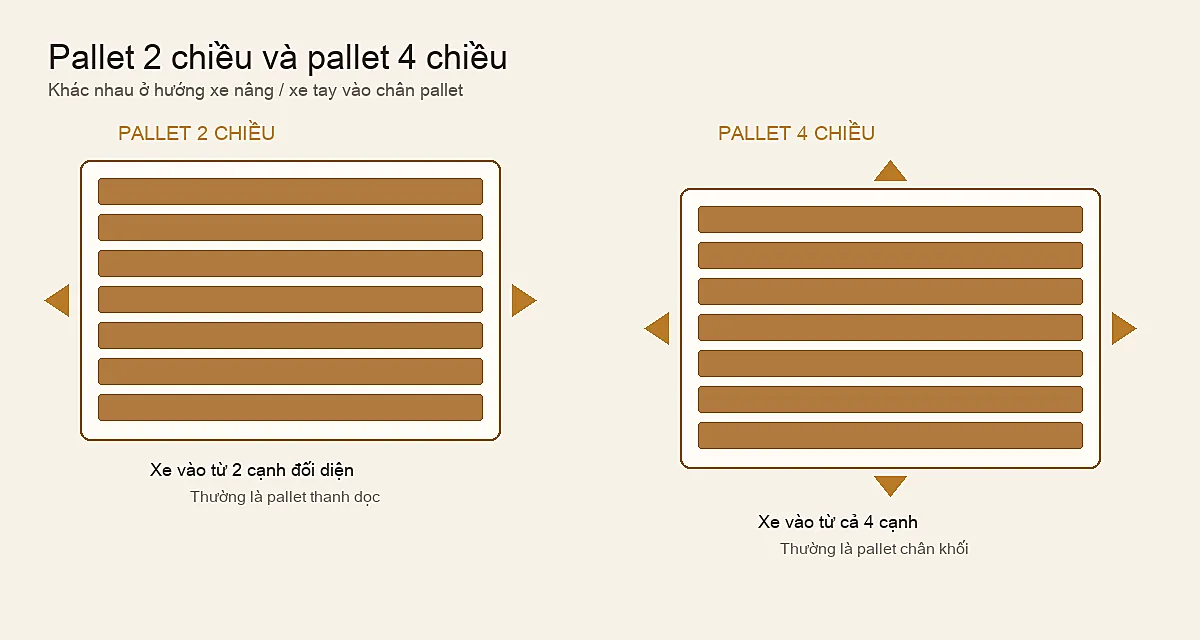
The difference between 2-way and 4-way pallets is... forklift directionThis is not about the pallet dimensions. A 2-way pallet allows the vehicle's forks to enter from opposite sides. A 4-way pallet allows the vehicle to enter from all four sides.
This article compares 2-way and 4-way pallets to help warehouse and procurement staff choose the right type before ordering acacia wood pallets. Incorrect lifting direction can clog aisles, slow container loading, and misalign shelves. Pallet surfaces must still be marked with millimeters; see standard pallet size.
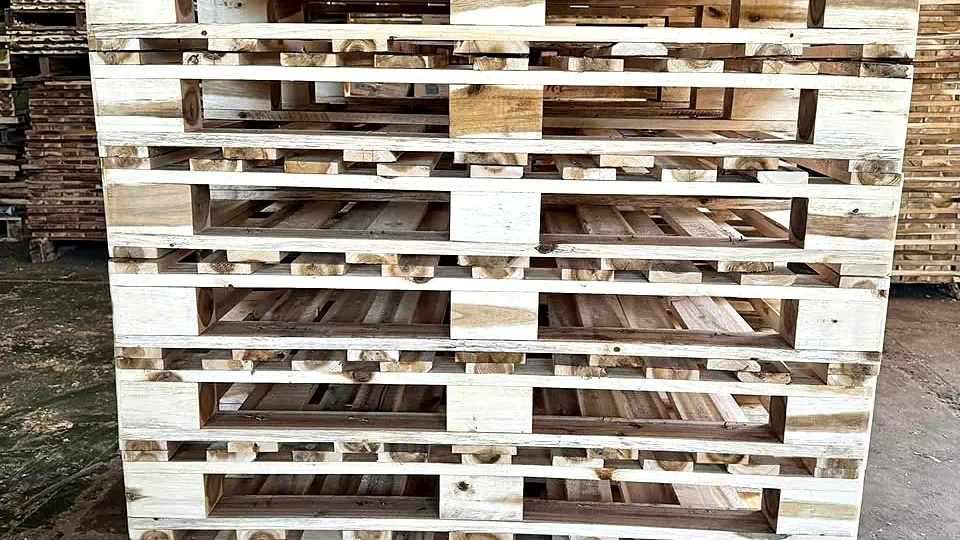
What is a two-way pallet?
A two-way pallet is a pallet that only allows forklift or hand truck access. two opposite sidesThe other two sides are blocked by stringers or footings, preventing the vehicle from maneuvering.
Common configuration: slatted top running in one direction, two (or three) longitudinal beams at the bottom. Vehicles enter through the opening. Warehouses with fixed, one-way vehicle access are usually sufficient for this type.
2-way and 4-way pallets They are not different in terms of load capacity. It's simply because of the number of entry points. The continuous support beam on a two-way pallet usually provides good support for the face slats at two long support points. The load still depends on slat thickness, slat spacing, wood type, and stacking method. See wooden pallet load.
When are two-way pallets suitable?
- The vehicle aisle in the warehouse is single-axis, eliminating the need to retrieve pallets from the side.
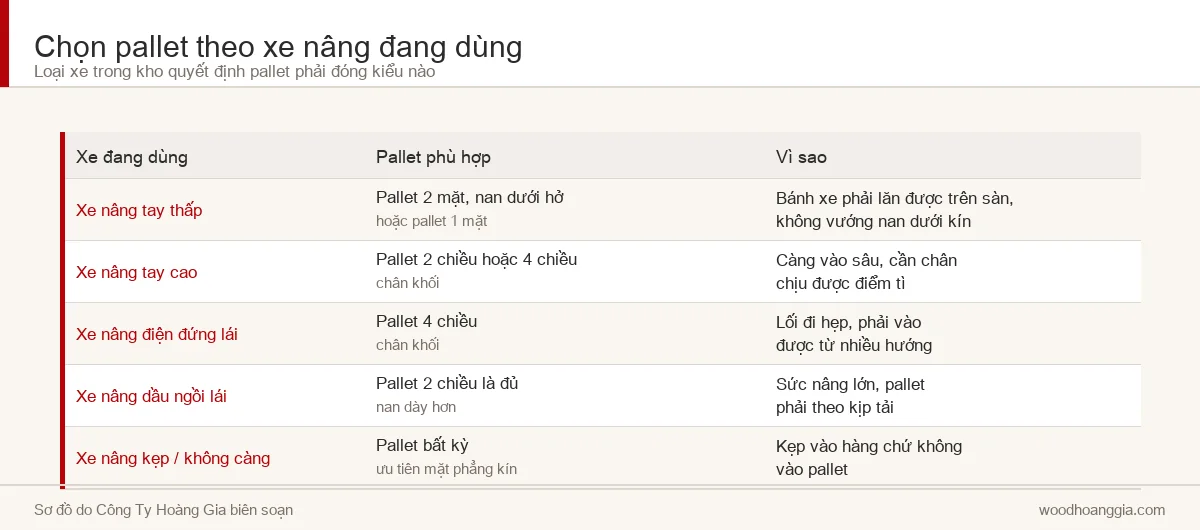
- Use multiple handcarts: the two openings should be wide enough for the handcart wheels.
- We want a simple structure that can be easily reassembled if the slats are damaged.
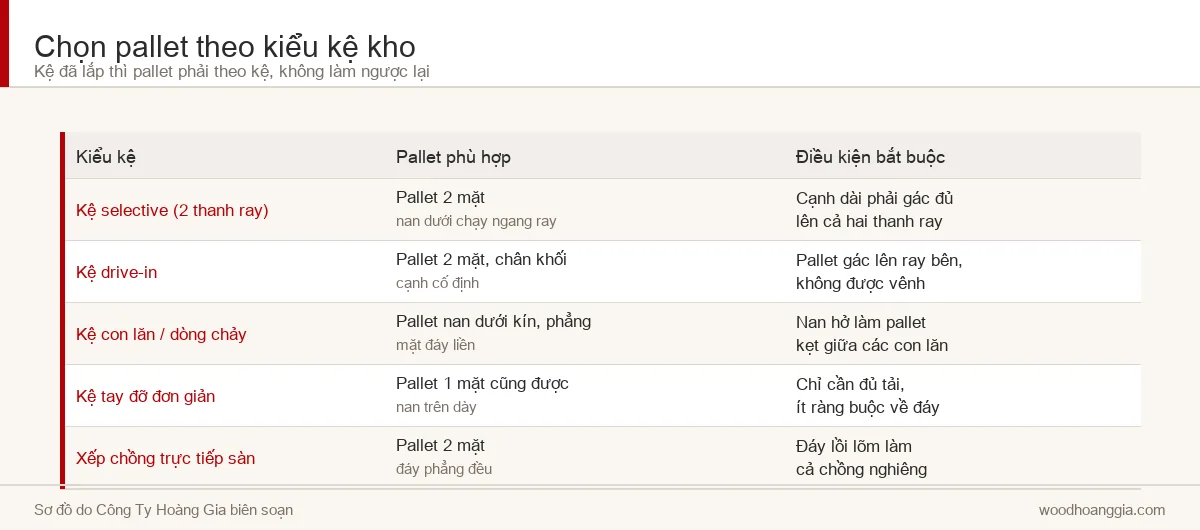
- Domestic goods, selective racking with pre-set lifting direction.
Disadvantages: reversing pallets in a container or on a narrow truck requires rotating the entire load. Drive-in racks or T-racks where the truck can only access the tight edges will get stuck.
Royal Company is currently selling these. 2-way acacia wood palletsThe order must still specify dimensions, single-sided or double-sided, and static/dynamic load.
What is a 4-way pallet?
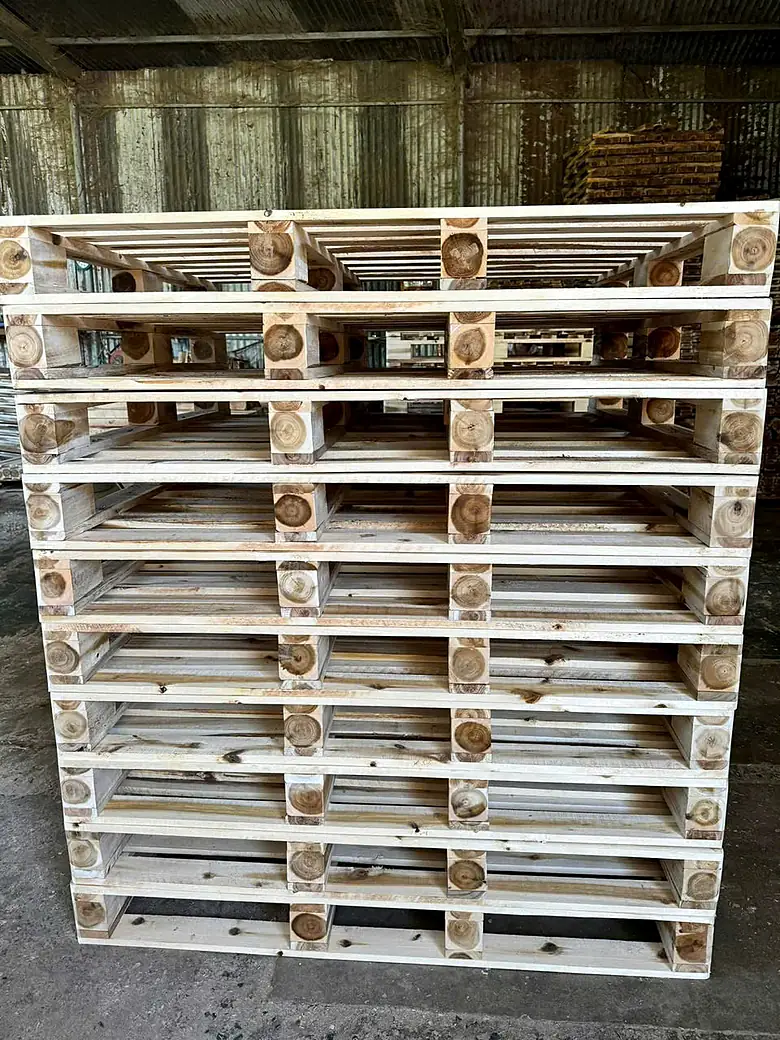
A 4-way pallet is a pallet designed for vehicle forks to fit onto. all four sidesThe warehouse keeper retrieves the pallet from the end or side without having to rotate the entire stack.
There are two common types of confusion:
- 4-dimensional — Open on all four sides, usually with block-footed pallets. Forklifts and various types of hand trucks can access from all four directions.
- 4-way notched (notch) — The support beam has notches cut along both sides. Forklifts can access from four sides; handcarts are also allowed. point to the two open sidesBecause the handwheel doesn't fit completely into the groove.
The order must specify "4-way access, how many sides are accessible by hand trucks". Simply writing "4-way pallet" is not sufficient.
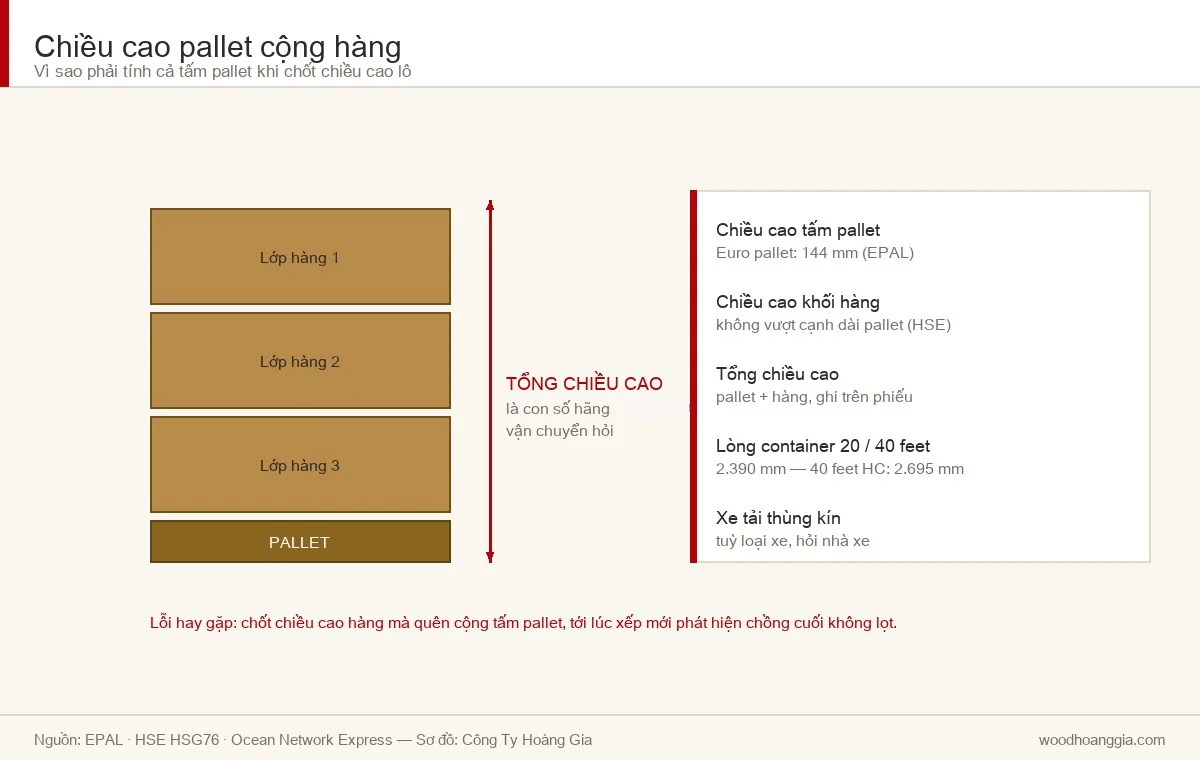
The Euro EPAL 1 pallet (800 × 1200 × 144 mm) is a 4-way pallet. EPAL product catalogAcacia wood pallets manufactured in Vietnam. same size EPAL does not equate to being authorized to use the EPAL seal.
When are 4-way pallets suitable?
- The warehouse has multiple access points, and trucks pick up goods from two axles.
- When loading a container, the pallet needs to be rotated to fit snugly inside the container.
- The shelving and loading platforms are not aligned in the same lifting direction.
- Many types of vehicles (sit-down lifts, stand-up lifts, hand trucks) share a single pallet surface.
Disadvantages: more complex manufacturing process. If the notches are cut carelessly, the support beam will be weak where the vehicle will hit it. Both 2-way and 4-way pallets must have the load specified on the order form — 4-way pallets cannot support more weight on their own.
The Royal Family has a lineage 4-way acacia wood palletsIt is possible to request ISPM 15 fumigation when goods arrive at the border.
Comparison table of 2-way and 4-way pallets
The table below compares 2-way and 4-way pallets on the same floor (e.g., 1,200 × 1,000 mm). The units of comparison are lifting and handling directions in the warehouse, not prices.
| Criteria | Two-way pallet | 4-way pallet |
|---|---|---|
| Vehicle direction | 2 opposite sides | 4 sides |
| Scooter | Usually, good entry from both sides. | True four dimensions: four sides; notched: usually two sides |
| Rotating inside the container | The entire block must be rotated if it's misaligned. | Linh is more agile when the sides are reversed. |
| Single-axis warehouse access | Enough for use | Optional, but not mandatory. |
| The warehouse entrance has many branches. | Easily gets stuck at tight edges. | More suitable |
| Bottom structure | The beam is a single piece, with few details. | Grooved base or beam |
| Repair the beams/girders. | Usually simple | Grooves and block edges are more difficult to repair. |
| Common mistakes | The direction of the face is missing. | It says "4 directions," but the handcar doesn't fit along the groove. |
2-way and 4-way pallets no change finalization One side or two sides?Single-sided pallets have slats on the top; double-sided pallets have slats on both the top and bottom, making stacking or conveyor belt operation more stable. They can be ordered as 2-way-1-sided, 2-way-2-sided, 4-way-1-sided, or 4-way-2-sided configurations. These four combinations must be listed separately in the quotation.
Also, don't confuse "4-way pallet" with "Euro pallet". Euro/EPAL 1 is one and the same. size + structure Specifically, a 4-way pallet can be 1,200 × 1,000 mm, 1,100 × 1,100 mm, or other specifications.
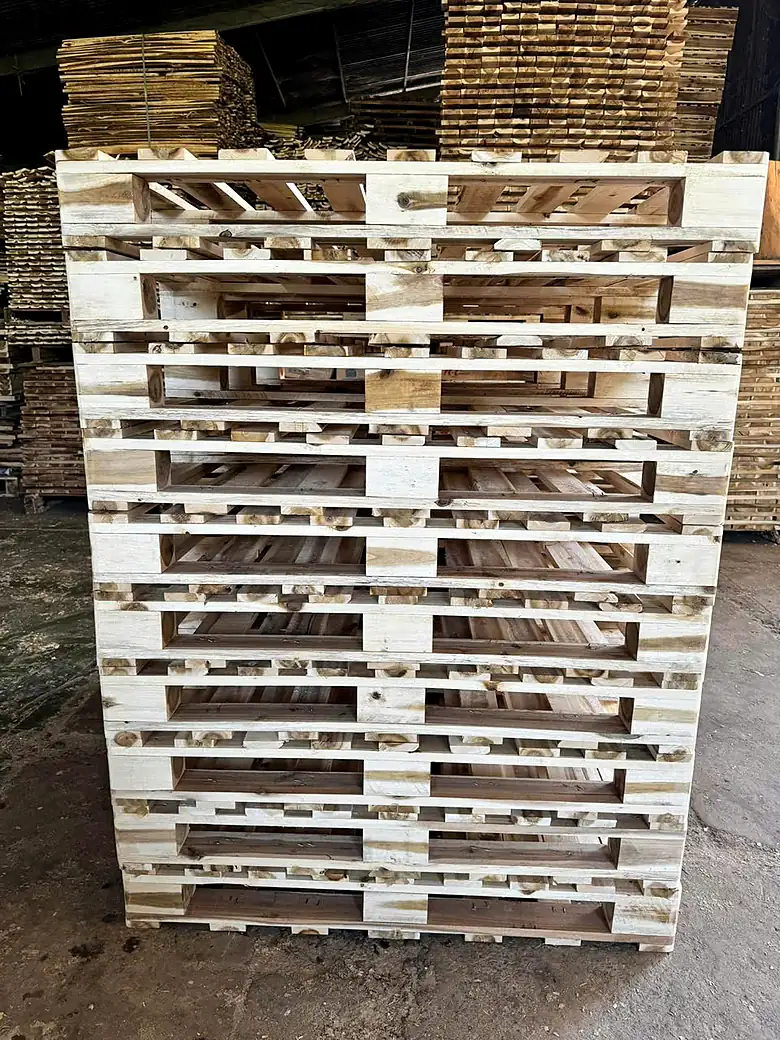
Two-way and four-way pallets: which type is best for your warehouse?
Select by The existing aisle and shelvingDo not choose according to factory conventions. Even 2-way and 4-way pallets of the same size will still be misaligned in the warehouse if the lifting direction does not match.
Select 2-way pallet When:
- The warehouse layout has a one-way main entrance, with vehicles always entering along the same pair of sides.
- The handcart is the main tool; it needs a wide opening and an unnotched bottom.
- Domestic goods, less frequent pallet shifting when loading into containers.
Select 4-way pallet When:
- The cart picks up goods from both the end of the shelving and from the side aisle.
- 20' / 40' closing time: container interior is approximately 5.90 × 2.35 m; rotating a 1,200 × 1,000 mm pallet to fit the goods requires the shorter edge to be accessible.
- Warehouse for rent, layout changed; don't want to be stuck in one direction for lifting.
Before finalizing the 2-way and 4-way pallets, measure four things and record them on the order form:
1. Vehicle orientation relative to the shelf surface. 2. Vehicle type: forklift, hand trolley, or both. 3. Leg opening/groove — is there sufficient height for the hand trolley wheels? 4. Single-sided or double-sided; spacing of the slats.
Send photos of the shelving and the pallet truck to the factory. Don't just message "make 4-way pallets like last time" if the sample wasn't available last time.
Export: The customer receiving the goods may have already set up the racks according to Euro 4-way orientation. Ask them which orientation they prefer. Pallets labeled "EPAL size" must still be marked as 2-way or 4-way, because the factory can assemble 800 × 1200 mm pallets in a 2-way style if no one confirms otherwise.
Royal offers both 2-way and 4-way pallets.
Hoang Gia Company manufactures acacia wood pallets in Ho Nai, Dong Nai. Both 2-way and 4-way pallets can be assembled on the same surface. Both lifting directions are shown on the website.
- Two-way acacia wood pallets — Domestic warehouse, single-axis access.
- 4-way acacia wood pallet — Warehouse with multiple entrances, container loading.
A single 1,200 × 1,000 mm pallet can be closed in 2 or 4 directions. Years of service and load capacity for each model: see quotation. The Royal Homepage lists acacia wood pallets designed for heavy loads. from 1 to 2 tons — That's a general range, not a measurement for a single SKU.
Request for quotation: Please provide dimensions (mm), specify whether you want 2-way or 4-way pallets, single-sided or double-sided, whether hand trucks need access from all four sides, whether ISPM 15 fumigation is required, and the quantity. Contact form: woodhoanggia.com/lien-he.
Frequently Asked Questions
Two-Way vs Four-Way Pallets: The Difference
The difference lies in the direction the forklift forks enter. Two-way and four-way pallets can have the same surface dimensions. Two-way pallets only open on opposite sides. Four-way pallets open on all four sides, or open on two sides and notched on the remaining two. The lifting direction must be indicated on the pallet, not "large pallet / small pallet".
Are 4-way pallets stronger than 2-way pallets?
It's not automatically stronger. Strength depends on the thickness of the slats, the spacing between slats, the type of wood, the bottom beam, and how the goods are stacked. A two-way pallet with a solid bottom beam may be stronger than a four-way pallet with a loosely strung bottom. Static and dynamic load limits are separate; don't use the direction of entry as the tonnage.
Can a hand truck handle a 4-way pallet?
It is passable if the bottom opens wide enough for the hand truck wheels. A true 4-way pallet (block base, open on all four sides) usually allows hand trucks to enter from all four directions. Pallets with only notches on the support beams usually only allow hand trucks to enter from two open sides. Clearly state on the order form: how many sides the hand truck can enter from.
Is it possible to order items of the same size, but with one part being 2 dimensions and the other 4 dimensions?
Yes, if the warehouse actually uses two layouts. Don't mix the same internal code. Attach the lifting direction indicator to the first slat. A factory should keep 1–2 main assembly sets; mixing multiple directions causes warehouse staff to pick the wrong items and jam the shelves.
Are single-sided/double-sided pallets the same as two-way/four-way pallets?
No. 1-sided and 2-sided refer to the number of sides with spokes. 2-way and 4-way refer to the direction of vehicle entry. Four independent combinations. Orders must include both groups. Missing one group means the factory is packing according to habit, easily leading to discrepancies in inventory.
Câu hỏi thuê pallet hay mua pallet nghe như bài toán tài chính, nhưng thực ra nó gọn về một câu hỏi vận hành duy
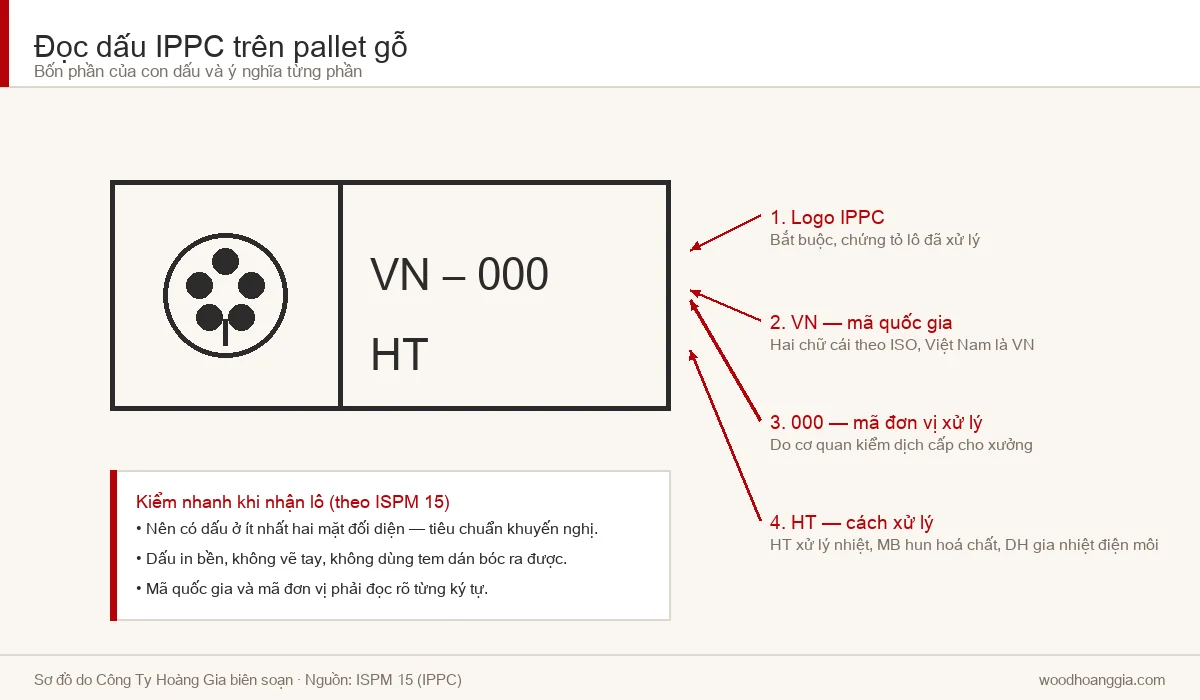
Trên mặt bên của pallet gỗ xuất khẩu luôn có một con dấu nhỏ hình chữ nhật. Nhiều người quen gọi là dấu hun trùng,