
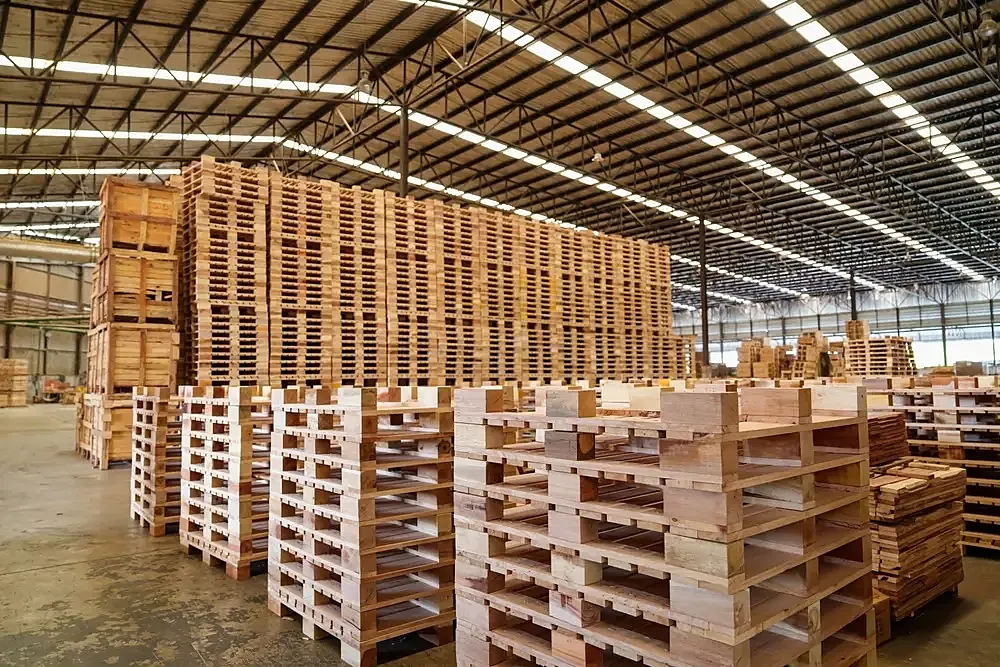
Proper storage of wooden pallets involves keeping them dry, well-ventilated, free from water damage and corrosive chemicals, and ensuring that broken pallets are not mixed in with good ones. If done correctly, the slats will be less prone to mold, insect infestation, and nail damage—allowing the pallets to be reused for more forklift cycles.
This article is for factory warehouse managers. The six tasks below can be done immediately, without the need for any special equipment. Hoang Gia Company's acacia wood pallets also follow the same rules when entering your warehouse.
Where do you begin with preserving wooden pallets?
Preserving wooden pallets starts with... parking spaceIt doesn't start with paint or chemicals. Choose a dry, well-ventilated area, elevated off the floor, and with a roof. Six steps in order: ensure ventilation, elevate the area, protect from rain, protect from corrosive chemicals, separate damaged pallets, and rotate them in the warehouse.
If you wait until the pallets are wet to "deal with" them, the slats will be saturated with water and the nails will rust. Fixing the problem in the right place is cheaper than repairing the whole batch. Export pallets have already been stamped. ISPM 15 It still needs to dry — it's not rainproof.
Inspection upon arrival also serves to protect the wooden pallets. Rain, wet slats, broken pallet legs—separate them immediately, don't load them all together. A record at the gate is cheaper than repairing the entire rack later.
Step 1: Leave the pallet in a well-ventilated area.
Stack the pallets so that air can circulate between them. If placed tightly against a wall or a hot corrugated iron ceiling, leaving no room to breathe, condensation will form in the slats, causing mold to appear on the surface.
Instructions for use in the warehouse:
- Leave forklift access; do not use aisles for stacking excess pallets.
- Do not seal all four sides with tarpaulin if the warehouse is already damp.
- Open windows or use a fan when it's humid. Wooden pallets absorb moisture from the air.
Storing wooden pallets in a sealed, air-conditioned warehouse still requires regular mold checks. When the air conditioning is off on weekends, condensation from the metal sheets drips onto the pallets—right where damage occurs.
Step 2: Elevate it off the ground.
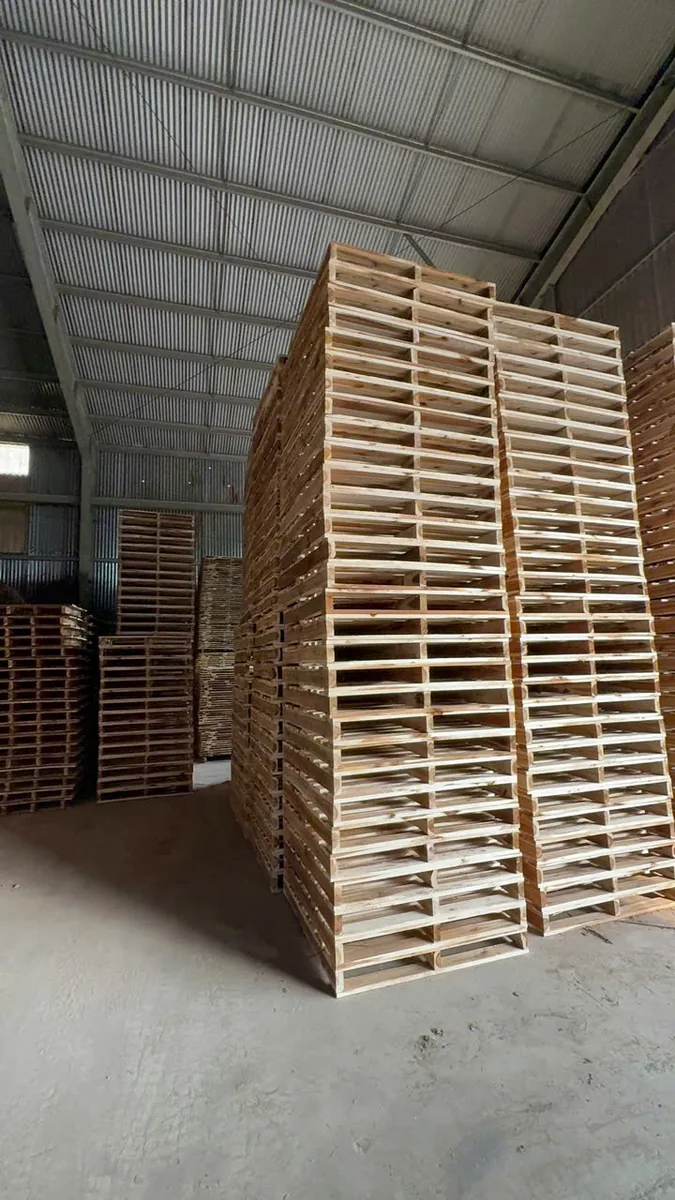
The warehouse floor, yard, and truck bed all have standing water. Pallets placed close to the cement will absorb moisture from below. The bottom slats will rot first, and the legs will break when the forklift drives over them.
Elevate it using:
- Wooden planks for lining, discarded (clean, termite-free) damaged pallets, or concrete bases.
- Do not use wet cardboard, fertilizer bags, or pallets with spilled chemicals as support.
Stack the finished pallets of goods high. Don't let the bottom layer "sacrifice" itself for the layer above. wooden pallet load Before the stack gets too high — storage cannot be reloaded.
Step 3: Avoid rain and standing water.
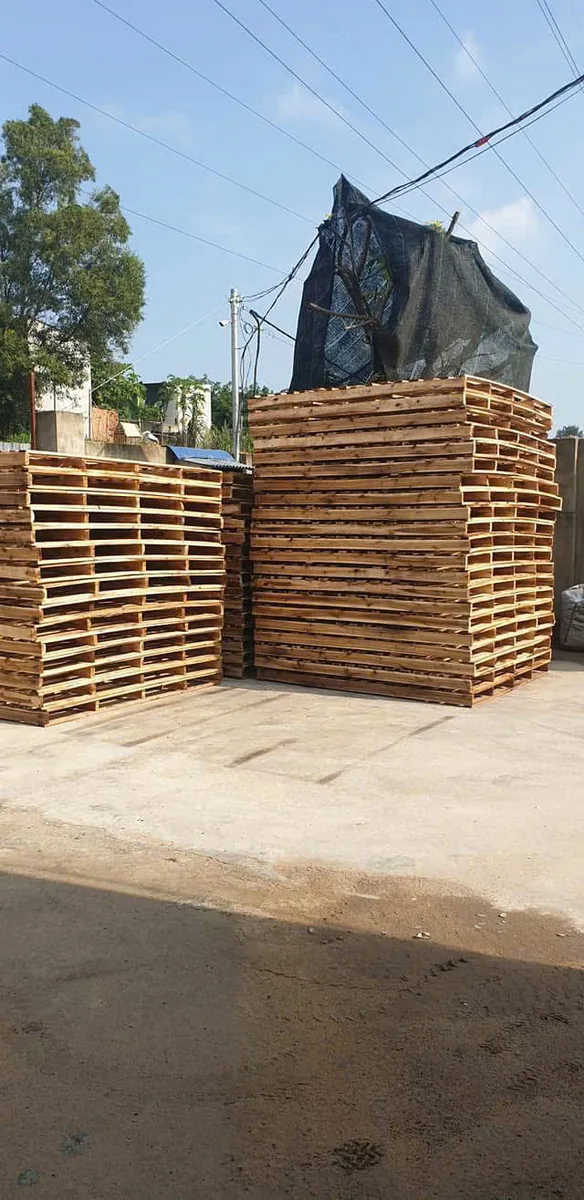
Direct rain seeps into the wood grain. Sunlight after the rain causes the slats to shrink quickly and crack lengthwise. Pallets left in an open yard should only be used as temporary waiting areas for vehicles during the day, with a tarp and support.
Things to do:
- A canopy over the area where pallets are stored awaiting use.
- Don't leave puddles under your husband's feet. Sweep and clear the ditches.
- Pallets arriving from the truck in the rain: separate them, let them air dry, and then stack them clean.
- Do not wash pallets with a high-pressure hose and then stack them immediately.
Fumigated pallets were still damaged by the rain. ISPM 15 Pest control, not waterproofing.
Step 4: Prevent chemicals from damaging the wood.
Acids, alkalis, solvents, fertilizers, and industrial wastewater corrode the slats and nails of pallets. Pallets carrying chemicals without padding or wrapping are then returned to stacks of clean pallets—leaving the entire warehouse tainted with odors and corrosion.
Warehouse rules:
- Pallets for chemicals: mark separately, do not mix with food or textile shipments.
- Do not place pallets under valves, tanks, or chemical shelves.
- Spills: Separate pallets, clean up according to factory regulations, do not tuck the spilled material between stacks.
- Paint, dyes, and machine oil adhering to the wire mesh: remove from the clean shipment.
Wooden pallets in food and chemical plants should not be stored in the same stack. Pallets contaminated with chemicals should be marked separately and not returned to the clean lot.
Step 5: Separate the defective pallets from the good batch.
Pallets with broken slats, holes in the surface, misaligned legs, or heavily infested with termites and mold must be moved to a separate area immediately. If mixed in, forklifts will still pick the wrong items, causing goods to spill; termites and mold can spread to intact slats.
Damaged pallet area:
- There are signs and floor markings.
- Not as high quality as the good batch.
- Decisions of the week: If it can be fixed, then fix it.Otherwise, remove the remaining slats and discard the rotten parts.
Don't just temporarily nail things together and then return them to the finished goods warehouse. Patch up broken pallets right when they're on the shelves. Newly purchased batches from the Ho Nai factory must also be inspected upon arrival — if damaged during transport, make a report; don't just accept them without inspection.
Task 6: Inventory Rotation
Pallets sitting at the bottom of a stack for months will become damp, dusty, and infested with termites. New batches are placed on top, and the old ones are never removed — a classic case of hidden spoilage.
Simple rotation:
- First-in, first-out (FIFO) shipments with pallets of the same size.
- Any stack that stands for too long: take it down, inspect it, and only then can it be stacked again.
- Separate by size. Mixing 1,200 × 1,000 with 1,200 × 800 caused the warehouse manager to pick the wrong item, resulting in a shelf jam.
Pallets are packed from Kiln-dried sawn acacia wood It still needs to be rotated. Drying at the factory won't keep it moist forever if your warehouse is wet. Storing wooden pallets is a weekly task, not something to be done when they arrive.
Weekly checklist for maintaining wooden pallets.
Print this sheet and post it in the warehouse. One person is responsible, one day a week.
| Job | Achieved when |
|---|---|
| Leave it to air dry. | There are ventilation openings, but the warehouse is not completely sealed with tarpaulin. |
| Elevate | No slats are lying close to the puddle/wet ground. |
| Avoid the rain. | It has a roof; the wet plot has been separated. |
| Avoid chemicals | Chemical pallets are marked, not mixed batches. |
| Separation failure | Separate area, no more broken pallets in the good lot. |
| Rotation | The old batch has been inspected/put into use. |
If a line is missing, fix it that week; don't wait for the "full cleanup" period.
We need new pallets to replace the damaged ones. Contact Hoang Gia WorkshopSend the correct dimensions (mm, 2/4 sides), load on the form.
Frequently Asked Questions
Can wooden pallets be left outdoors?
For short-term use, they need to be elevated and covered with tarpaulin or roof. Alternating rain and sun cause the slats to crack and the nails to rust. Pallets waiting for trucks during the day are acceptable. Pallets used for several months must be stored in a well-ventilated warehouse. Even fumigated pallets cannot withstand prolonged rain.
Is it necessary to periodically spray wooden pallets with termite control chemicals for preservation?
Not necessarily. The main thing is to keep the area dry, well-ventilated, elevated, and separate the termite-infested pallets. Spraying must follow factory regulations — food warehouses usually prohibit chemicals near goods. Ask the safety department before spraying. Heavy termite-infested pallets should be discarded; don't spray them and then return them to a good batch.
Are pallets with slight mold still usable?
For surface mold, if the slats are still intact and the goods are not food: let them dry, scrape off the mold, inspect them again, and then use them internally. For export goods or food: separate them and ask the recipient if they accept them. Do not scrape off the mold and immediately pack them in food containers.
What is the safe height for stacking pallets?
There is no single standard for all warehouses. It depends on the load on each pallet, the floor surface, and the forklift. Stacks must be straight, not tilted. Overloading the bottom layer will cause the bottom slats to break even with excellent storage. Use the static load specified on the order form; do not stack "another layer to avoid overcrowding."
Do ISPM 15 fumigated pallets require any other storage methods?
Six things to do. Plus: keep the IPPC mark legible, don't paint over it, don't sand the mark. Wetness and mold will still cause customers to reject the goods even if the mark is still there. Separate broken pallets to avoid having to reprocess the entire batch when shipping.



Câu hỏi thuê pallet hay mua pallet nghe như bài toán tài chính, nhưng thực ra nó gọn về một câu hỏi vận hành duy

Trên mặt bên của pallet gỗ xuất khẩu luôn có một con dấu nhỏ hình chữ nhật. Nhiều người quen gọi là dấu hun trùng,