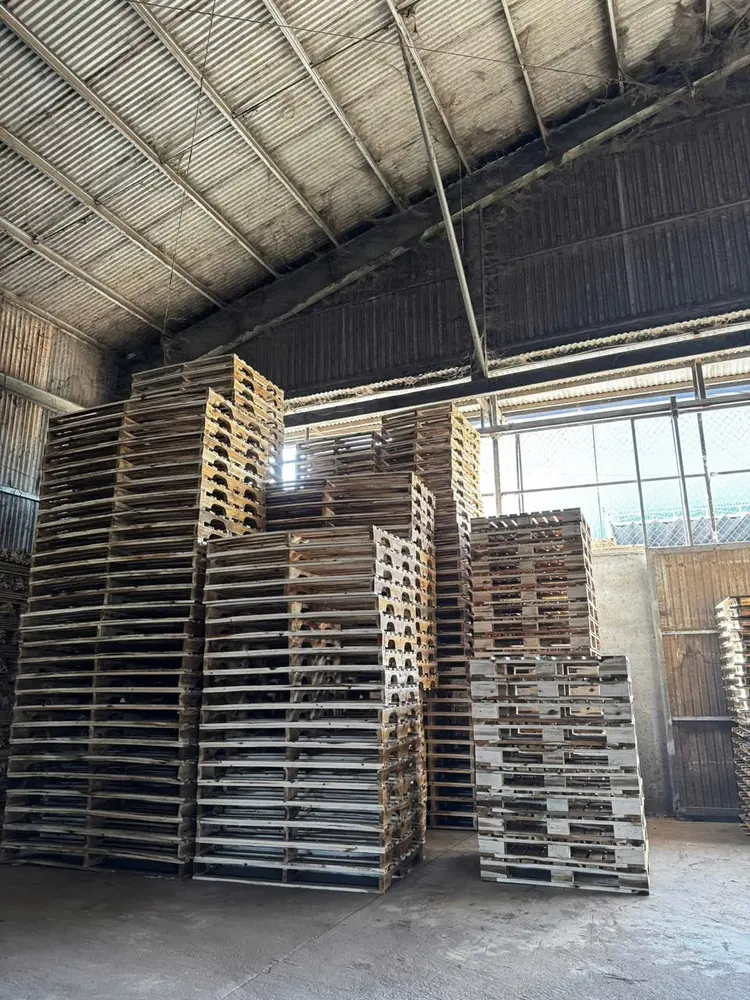
Repair wooden pallets This involves replacing or reinforcing a damaged pallet so it can be used again, instead of discarding it. This is only beneficial in certain specific cases — outside of those, repairs will still result in breakage and cost more than making a new one.
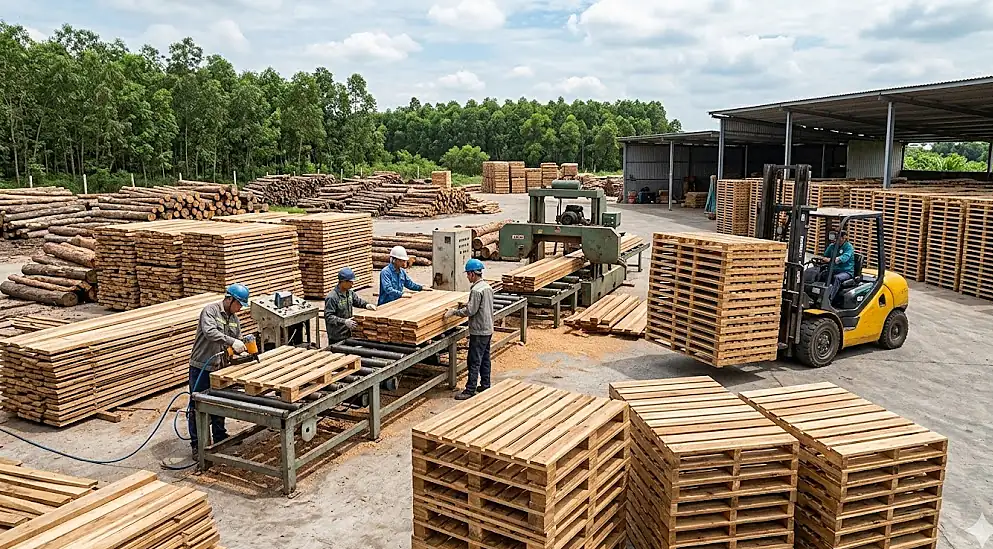
The instructions for warehouse and maintenance staff require a clear threshold: when to use a hammer, and when to move items to the sorting area. Hoang Gia Company manufactures new acacia wood pallets according to specifications in Ho Nai, Dong Nai.
Four common mistakes when self-repairing in the warehouse.
Most repaired pallets break prematurely not because of poor quality wood, but because of the following four steps.
- Nail over the old hole. — The wood grain there is rotten, the nail won't hold.
- Use thinner strips than the original strips. — creates a concave area right in the middle of the face.
- Mixed wood species — Different types of wood shrink differently, and joints may loosen after a few weeks.
- Pay directly to the finished goods warehouse. — Do not attempt to load, do not mark as fixed.
Any repaired vehicle should be marked and its load reduced compared to the original. The method for determining the number is in the article. wooden pallet load.
Pallet sorting procedure before repair
Sorting before hammering saves maintenance staff the trouble of dealing with items that will have to be discarded anyway. The three steps below can be done right at the assembly area, without the need for measuring equipment.
- Turn it over and examine the legs and front frame. If the legs are cracked or the frame is warped, stop immediately and move it to the rejection area — no need to examine the slats further.
- Tap and shake. The popping sound and looseness at the joint indicate that the nail has loosened over a large area. Those with a lot of looseness should be rejected.
- Count the damaged slats and locate them. Damage to a single slat in the middle of the face is put into the repair category; damage directly on the leg or to several adjacent slats is rejected.
The three groups of results should be marked with three different paint colors or floor markings: ready to use, awaiting repair, and discarded. Without this marking step, the items awaiting repair and those discarded will be mixed up after just one shift.
After repair, the forklift should be tested with the correct type of load and in the correct forklift orientation before being returned to the main line. Testing with light loads and then drawing conclusions is a common way to overlook faults.
Another often overlooked point: recording the number of pallets that need to be discarded each month and the main reasons. Without this data, the warehouse won't know if it's losing money due to forklift handling, dampness, or incorrect initial placement. A simple three-column chart posted in the staging area, handwritten, is enough to see the trend after a few months.
Repair wooden pallets and export goods.
For shipments going abroad, repairs create a unique problem: the replacement wood is untreated. Wood packed for export must meet certain standards. IPPC's ISPM 15 standard, and the IPPC mark stamped on the old frame does not automatically cover the newly replaced slat.
The practical consequence: patched pallets often require a complete rework and re-stamping, or are rejected by the customer. Details of the process can be found in the article. ISPM 15 and pallet fumigation..
Therefore, many factories have a simple rule: pallets for the domestic market can be repaired, but pallets for export cannot be patched – damaged ones are rejected.
How can we reduce the number of pallets that need repair?
The cheapest way isn't to repair them faster, but to reduce the number of damaged pallets. Three groups of causes account for the majority of damage in the warehouse.
| Reason | Manifestations | Price reduction |
|---|---|---|
| Forklift operation | Chipped edges, broken legs, broken frame | Leave a way out, and carefully position yourself at the mouth of the cup. |
| Humidity and rain | Bottom slats, mold, rusty nails | Elevated above ground, with a roof, separated from wet plots. |
| Overloaded | Facial depression, fracture of the central rib. | Static and dynamic load locking on the slip |
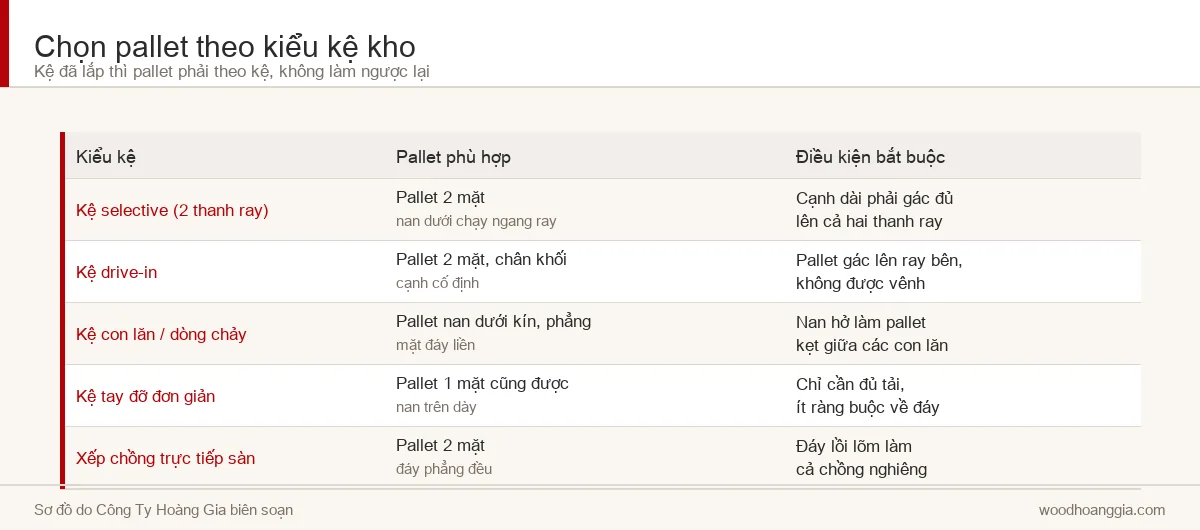
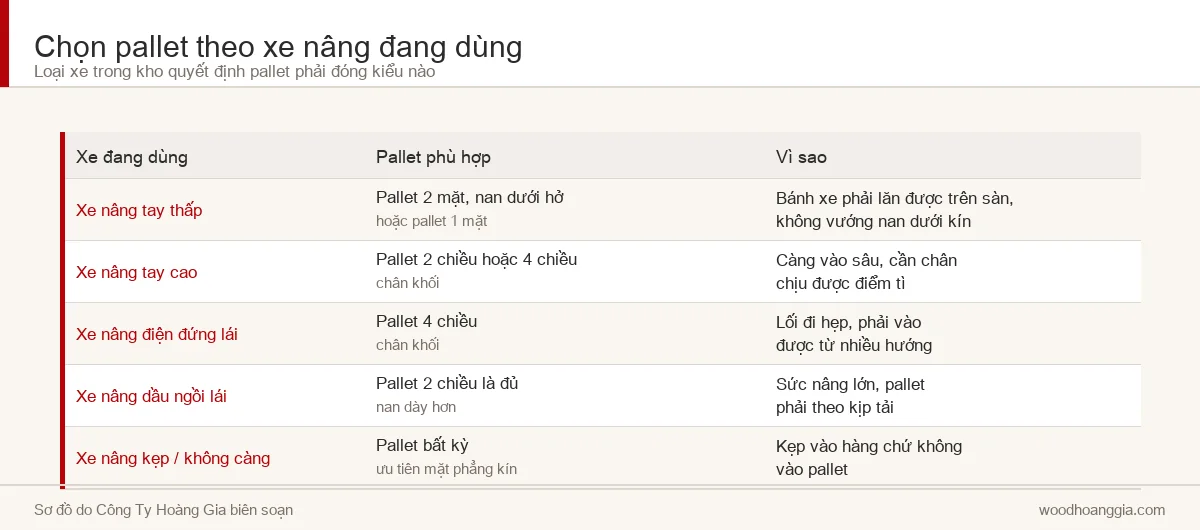
Choosing the right structure from the start also reduces damage. Warehouses that frequently reverse pallet loads should consider this. 2-way and 4-way pallets before finalizing the specifications.
When the number of defective batches exceeds the compensation limit, order a new batch of the exact same size. Royal Workshop It is still more economical than maintaining a patched pallet inventory.
Frequently Asked Questions
Is repairing wooden pallets cheaper than buying new ones?
It's cheaper to replace just one or two slats on a still-sturdy frame. It's no longer cheap when the legs are cracked, the nails are rusted, or the frame is warped. At that point, the labor cost for dismantling, the replacement wood, and the downtime in storage often exceed the price difference compared to building a new frame to standard specifications.
Can patched pallets be used for export goods?
High risk. The replacement wood must be treated according to ISPM 15 for the entire new piece to be valid; the old IPPC mark on the frame does not cover the newly replaced wood. Ask the recipient and the processing unit beforehand; do not assume the old mark is still valid.
How many broken slats should be discarded as a whole piece?
There's no general rule because it depends on the location. A broken slat at the base is much more dangerous than a broken middle slat. The practical principle is: if the damage is at the base, in the frame, or if many adjacent slats are broken, discard the damaged slat; if only a single middle slat on a good frame is damaged, repair it.
Do I need any special tools to repair wooden pallets in the warehouse?
No. A puller hammer, a small crowbar, twisted nails, and replacement slats of the same thickness are sufficient for replacing individual slats. What to avoid is nailing over old holes and using slats thinner than the original ones — both mistakes will cause the pallet to break again very quickly.
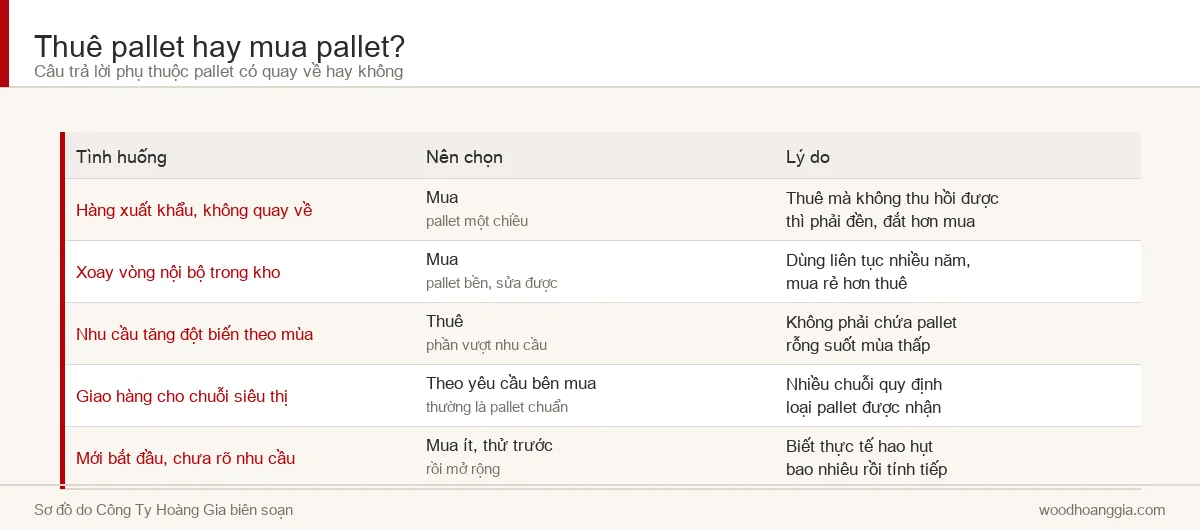
Câu hỏi thuê pallet hay mua pallet nghe như bài toán tài chính, nhưng thực ra nó gọn về một câu hỏi vận hành duy

Trên mặt bên của pallet gỗ xuất khẩu luôn có một con dấu nhỏ hình chữ nhật. Nhiều người quen gọi là dấu hun trùng,